Least-Invasive Approach
Knee Replacement. Without Cutting Muscle.
Most knee replacements cut through your thigh muscle to reach the joint. Dr. Fawzy uses the sub-vastus approach – working around the muscle, not through it. Less damage. Faster recovery. Used for over 30 years.
 WhatsApp Us
Quick Overview
When You Need It
The cartilage is gone. Bone grinds on bone – walking hurts, stairs are difficult, sleep is broken. You've probably already been told you need a replacement. You're here to find out who should do it.
Not All Replacements Are the Same
Most surgeons cut through your quad tendon to reach the joint. The technique trending on social media avoids the tendon but splits the thigh muscle instead. Dr. Fawzy avoids both – no tendon cut, no muscle cut.
The Sub-Vastus Approach
Dr. Fawzy goes around the muscle, not through it. Your quadriceps stays intact – ready to work from day one. Less pain early on because the muscle wasn't cut. Months later, you still have the advantage: the thigh muscle was never damaged. Stronger rehab, better long-term range of motion.
What to Expect
Home the same day or next morning. Walking within 24 hours. Because the quad wasn't cut, there's less pain early on and physio progresses faster. Most patients return to daily activities within 6–12 weeks.

Your Surgeon
Dr. Fawzy Issa – Consultant Orthopaedic Surgeon
- FRCS – Fellow of the Royal College of Surgeons, UK
- 40+ years of orthopaedic surgical experience
- Trained in top UK hospitals
- Fixes failed replacements from other surgeons – that experience with what goes wrong shapes how he does yours right the first time round
- Non-surgical treatment first when the knee can benefit. A clear answer when surgery is the right call.
- Offers partial replacements when the whole knee doesn't need it – up to half of patients may be candidates, but most surgeons default to total
The Full Story
For those who want to understand the approach in depth
Do I Actually Need a Knee Replacement?
Not every painful knee needs surgery. Dr. Fawzy's first question isn't whether he can operate – it's whether he should.
When replacement is the right call
Advanced arthritis – bone grinding on bone, cartilage gone, joint space collapsed on X-ray. You've tried physiotherapy, injections, anti-inflammatories, and the pain still limits your daily life. Walking is difficult. Stairs are worse. Sleep is broken. When conservative treatment has been given a genuine chance and the joint is structurally past the point of recovery, replacement is the right answer.
Less commonly, other conditions reach the same point: rheumatoid arthritis that has destroyed the joint surfaces, avascular necrosis where the bone loses its blood supply and collapses, or post-traumatic arthritis from an old fracture that has deteriorated over years.
When it can wait or be avoided
Early-to-moderate arthritis – the joint is wearing but cartilage remains. Before surgery enters the conversation, there's a toolkit Dr. Fawzy uses to manage pain and protect the joint:
Strengthening the muscles around the knee compensates for joint damage and reduces pain. In studies, structured physio delayed replacement in the majority of patients.
Cortisone reduces inflammation but has side effects when used alone. Hyaluronate lubricates the joint with fewer side effects. Combined, they're more effective – cortisone calms the flare while hyaluronate protects the joint longer-term.
Your own blood, processed and injected into the joint. PRP concentrates platelets and growth factors that promote tissue repair. APS goes a step further – a second processing stage that concentrates anti-inflammatory proteins targeting the arthritis process itself.
Cells harvested from your own fat or bone marrow, injected into the joint to support tissue repair and reduce inflammation.
Every kilogram of body weight puts roughly four kilograms of force through the knee. Even modest weight loss reduces pain and slows progression.
The goal is to delay knee replacement for as long as possible – or avoid it altogether. Dr. Fawzy offers and uses these treatments whenever the knee can genuinely benefit. A joint that responds to non-surgical care shouldn't be replaced.
Where Dr. Fawzy draws the line
Some knees are clearly past non-surgical treatment. Some clearly aren't. Some are in between. Dr. Fawzy's job during your consultation is to assess which yours is – based on X-rays, physical examination, how long you've had symptoms, and what you've already tried. If your knee needs replacing, he'll tell you. If it doesn't, he'll tell you that too.
Why the Approach Matters
Not all knee replacements are done the same way. The difference is in how the surgeon reaches the joint – and what gets cut in the process.
Cuts through the quadriceps tendon to reach the joint. Most surgeons learn this first and use it for every case. It works – millions of successful replacements are done this way – but cutting through the tendon that straightens your leg means it needs time to heal before the muscle can function properly. Early recovery is slower. The leg feels weak longer.
Doesn't cut the tendon – which is why you'll see it called the "not-cutting-the-tendon technique" on social media. But it reaches the joint by splitting through the vastus medialis muscle fibres instead. The tendon is intact. The muscle is not.
Goes underneath the vastus medialis muscle entirely. The muscle is lifted and moved aside – not cut, not split. The tendon is untouched. No muscle fibres are severed. Your quadriceps mechanism is completely intact when surgery ends.
The sub-vastus approach is technically the most demanding of the three, which is part of why not every surgeon uses it. It requires more experience to work within the tighter access. Dr. Fawzy has used it throughout his 40-year career.
What the intact quad means for you
You can start contracting the muscle immediately after surgery. Physiotherapy doesn't begin with healing. It begins with strengthening.
The long-term difference: patients whose quad was preserved tend to regain better range of motion and stronger functional recovery. The muscle that straightens your knee, that catches you on stairs, that lets you stand from a chair – it was never damaged. It just needs to get back to work.
Replacing Only What Needs Replacing
Your knee has three compartments – inner (medial), outer (lateral), and under the kneecap (patellofemoral). Arthritis doesn't always affect all three. When it doesn't, replacing the entire joint means removing healthy bone and cartilage that's still working. Dr. Fawzy matches the surgery to the damage.
When only the inner or outer compartment is damaged. Only the worn surface is replaced. The healthy parts of your knee – including the cruciate ligaments, your knee's own stability system – stay intact. Recovery is faster, and 90% of patients report the knee feels natural. This is because most of it still is.
When arthritis is isolated to the joint under the kneecap. Less common, but when it fits, it means replacing one surface rather than the whole knee. Shorter recovery, less pain, better range of motion than a total replacement for the same condition. Most surgeons would default to a total knee here. Dr. Fawzy offers the targeted option.
When arthritis has spread across the joint and there's no undamaged compartment to preserve. All worn surfaces are replaced with smooth metal and high-grade plastic components. This is the right call when the damage is widespread – and when it is, Dr. Fawzy's experience means it's done precisely.
The principle is the same one that runs through everything on this page: the minimum intervention that solves the problem. Non-surgical treatment when the knee can benefit. Partial replacement when only part is damaged. Total replacement when it's needed. And the sub-vastus approach for whichever surgery is right – the least invasive way to get there.
What Most Surgeons Never See
Dr. Fawzy regularly performs revision surgery – replacing implants that have failed or were done poorly the first time by other surgeons. He sees what a knee replacement looks like years after it was aligned wrong, or when the ligament balance wasn't right, or when the implant was sized incorrectly.
That knowledge is in the room for every primary replacement he does. A surgeon who's seen how things fail knows what to get right from the beginning.
Recovery
Most patients go home the same day or the next morning. You'll be walking, with support, within 24 hours. That's standard for any knee replacement – early mobilisation reduces complications and shortens hospital stays.
Where the sub-vastus difference shows up
With the standard approach, the first days are harder. The quad muscle was cut to access the joint, and now you're being asked to use it. It hurts. Activating the muscle takes longer. The straight leg raise – the basic test of quad function – can take days to achieve.
With the sub-vastus approach, the quad was never cut. Patients typically achieve a straight leg raise within hours of surgery, not days. There's less pain in the first week because the muscle is intact. And because the quad works from day one, physiotherapy progresses faster – you're building strength from the start rather than waiting for tissue to heal before you can begin.
These three things compound: less pain means you engage with physio more willingly, working quad means the exercises are effective sooner, and faster early progress builds momentum through the rest of recovery.
The timeline
Walking with support. Straight leg raise (with sub-vastus, often within hours).
Daily exercises to restore range of motion. Walking distances increase. This is the hardest stretch – most patients say it gets noticeably easier after week two.
Increasing independence. Longer walks, stair climbing, driving (usually around 4–6 weeks).
Return to most daily activities – cooking, shopping, desk work. Light activities like swimming and cycling.
Full recovery. The knee stops feeling like a replacement and starts feeling like yours. Strength and confidence continue building.
What affects how long it takes
The range is wide because people are different. The biggest variables: your fitness going in (stronger muscles pre-surgery mean faster rehab), body weight (less load on the joint helps), age and overall health (diabetes or heart conditions can slow healing), and how consistently you do your physiotherapy. Of these, physio adherence is the one you control most – and it makes the biggest difference.
The surgery gives you a new joint surface. The rehab gives you a functioning knee. Both are essential.
Common Questions
How long does the implant last?
Modern knee implants can last up to 30 years. Dr. Fawzy's experience with revision cases – seeing what causes implants to fail early – directly informs how he positions, aligns, and balances yours to maximise its lifespan from the start.
Am I too old for knee replacement?
Age alone doesn't determine whether surgery is right for you. Overall health, bone quality, and how much the knee affects your daily life matter more than the number. Dr. Fawzy regularly operates on patients in their 70s and 80s.
Will I be able to kneel and pray after surgery?
Many patients return to kneeling for prayer after recovery. The degree of comfort varies – some kneel fully, others use a slightly modified position. Dr. Fawzy can discuss your specific situation during consultation.
What type of anaesthesia is used?
Most knee replacements are done under spinal anaesthesia – you're awake but feel nothing below the waist. General anaesthesia is available if preferred. The best option for you is discussed before surgery.
What if I need both knees replaced?
Yes. They can be done simultaneously under one anaesthesia, but staged surgery – one knee at a time, 3–6 months apart – is typically safer. The recovered knee becomes a strong support during the second rehab, and the risks of blood loss and complications are lower than doing both at once.
How long does the surgery take?
A total knee replacement typically takes 1–2 hours. Partial replacements are usually shorter. The time varies depending on the complexity of the case.
Your Consultation
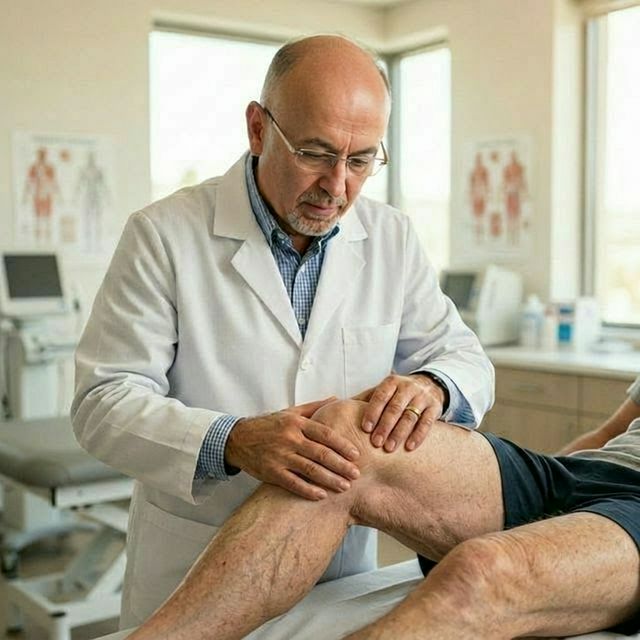
You'll start with X-rays and a physical examination. Dr. Fawzy looks at the joint, tests your range of motion, and assesses how the damage is affecting your daily life.
Then you sit down and talk. He explains what he sees, what your options are, and what he recommends. If your knee needs replacing, he'll say so clearly – what the surgery involves, what recovery looks like, what to expect long-term.
If there's a genuine chance that injections or physiotherapy could help, he'll tell you that too. But he won't suggest non-surgical treatment for a knee that's past that point.
You leave with a clear picture of where your knee is and what makes sense next.
The Next Step Is a Conversation
Dr. Fawzy will examine your knee, review your X-rays, and give you a clear recommendation.